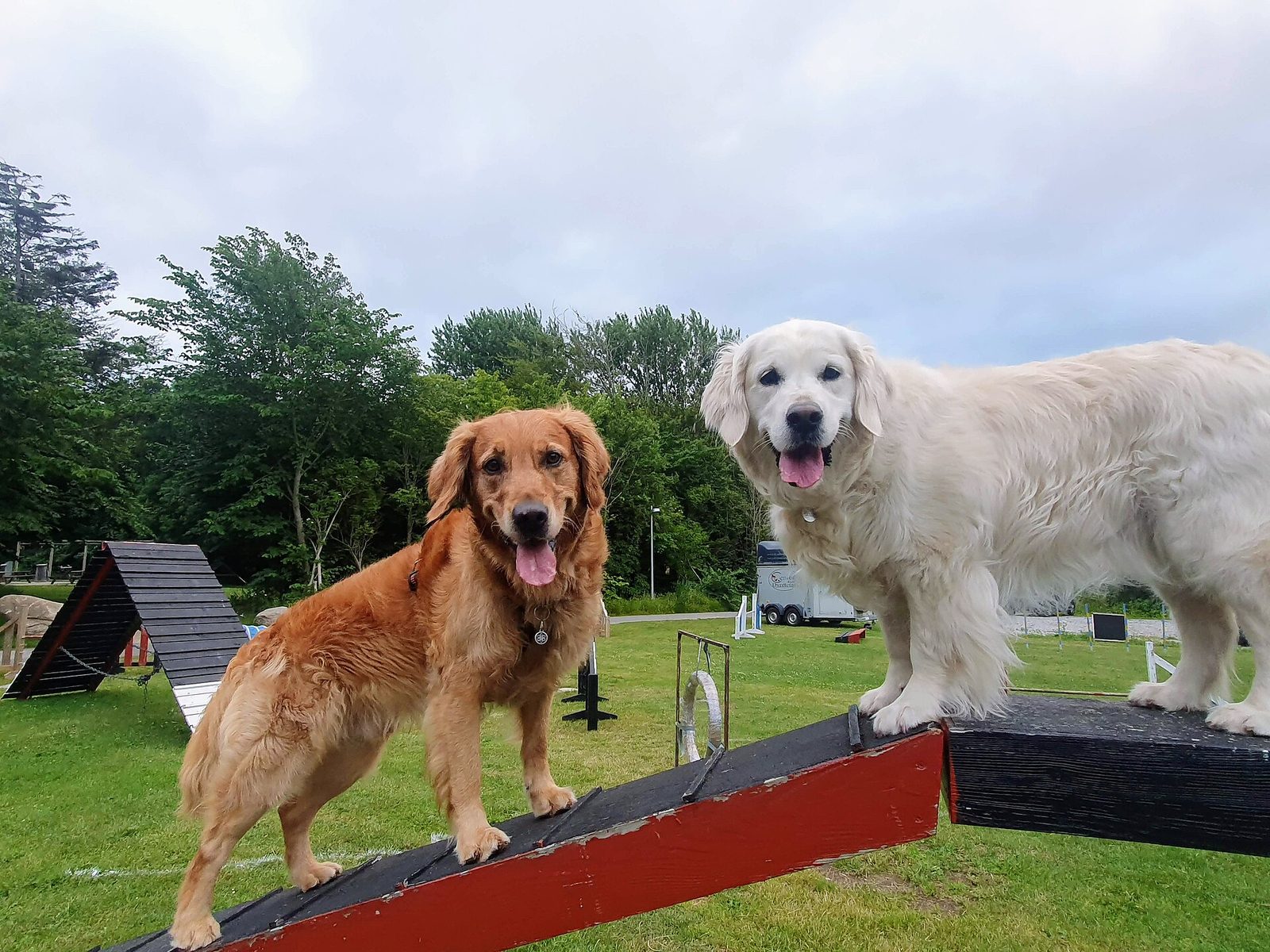
Recall isn't a word. It's a trained behavior with a reinforcement history — and yours may be broken.
"He completely ignores me." "I've tried everything." "He's perfect in the kitchen and deaf the second we hit the park." Nearly every owner who says those things believes the same quiet thing underneath: maybe my dog is just stubborn. He isn't. Stubbornness is a story we tell when we can't see the real mechanism. Here's the real mechanism.
Every time your dog ignored "come," something happened. They chose the squirrel, the other dog, the smell in the bushes. And they got it. The recall cue got weaker. The competing reward stayed strong.
Do that enough times and your dog isn't ignoring you — they've been trained, by consistent experience, that the word means nothing urgent.
That's not stubbornness. That's learning. Dogs do what works. If coming back worked better than not coming back, they'd come back. Right now, for most dogs in high-distraction settings, it doesn't.
The Bombproof Recall System fixes this in a specific order.
First, you un-poison the cue. The old word is retired. A new one gets built from scratch with a clean slate — charged with the best rewards your dog knows, in the easiest possible setting, with zero chance of failure. Fukuzawa & Hayashi (2013) showed that food reward produces the fastest, most reliable learning — which is why the new cue gets paired with the highest-value treats your dog has ever tasted. The new cue becomes the best word in your dog's vocabulary.
Then you ladder distractions. You don't go from living room to dog park. You build a progression: driveway, sidewalk, quiet park, busy trail, dog park. At each step, the dog succeeds. The reinforcement history gets thicker. The cue gets stronger.
Then you build the emergency recall — a separate, bombproof cue reserved only for life-or-death moments, practiced rarely enough that it retains maximum value, trained with maximum reward. Lesson 7 is the one owners tell us later saved their dog's life.
The science behind this is not complicated. Ziv (2017) documented that aversive training increases anxiety and avoidance — both of which destroy recall reliability. Vieira de Castro et al. (2020) showed that aversive training produces dogs with higher stress behavior. China et al. (2020) found reward-based training was at least as effective as electronic-collar training, with significantly fewer signs of stress.
Shock collar recall works through avoidance. The dog comes back to avoid pain. But avoidance motivation is fragile — it erodes under competing fear, confusion, or high enough distraction. Reward-based recall is approach motivation. The dog comes back because it genuinely predicts something better than what they're doing. Lazarowski et al. (2025) confirmed the effectiveness of marker training for building reliable behavior even in demanding detection-dog contexts, where the stakes are as high as they get.
Approach motivation is more reliable. It doesn't fade under pressure. It gets stronger with each successful rep.
When researchers ran a randomized controlled trial comparing electronic-collar recall against reward-based recall, the shock collar produced zero advantage in reliability — while raising the dogs' stress signals. The "shortcut" doesn't even buy you a better recall. It just buys you a more anxious dog.
— Cooper, Cracknell, Hardiman, Wright & Mills (2014), PLOS ONE 9(9), e102722; China, Mills & Cooper (2020)
What you'll be able to do by the end
By the time you finish the lessons, the lead-off moment stops being a gamble:
- You'll have retired the old, poisoned "come" and built a brand-new cue your dog finds genuinely impossible to ignore.
- You'll have laddered through real distractions — driveway, sidewalk, quiet park, busy trail — so the recall holds where it actually matters.
- You'll own a separate emergency recall, reserved and supercharged, for the deer-breaks-cover moments.
- And you'll finally let the long line drop, in the right place, at the right stage, with a plan instead of a prayer.
What a broken recall actually costs you
You already know the feeling. The lead comes off and your stomach tightens. You spend the whole walk reading the middle distance for the thing that's going to set them off — the jogger, the rabbit, the off-leash dog cresting the hill. You call once, hopefully. You call again, sharper. By the third call you're using the voice, the one that says to every other person in the park this dog does not listen to me.
So the lead stays on. The long line stays clipped. The fenced field you drive to twice a week becomes the only place your dog ever really runs. Their world shrinks to the length of a rope — and a dog who never gets to move freely carries a load of unspent energy into every other behavior you're trying to fix.
And underneath the inconvenience sits the real fear: the one bolt toward a road, a livestock field, or a dog that doesn't want company. A reliable recall isn't a party trick. On the wrong day it's the only thing standing between your dog and the worst phone call of your life.
Why the shortcut fails exactly when you need it most
This is the moment a lot of owners get talked into a shock collar. The pitch is seductive: press the button, the dog comes back, problem solved. In the back garden, it often looks like it works.
Then the real test arrives — a genuine high-value distraction, a deer breaking cover — and the collar fails the way avoidance learning always fails under pressure. The dog is caught between two things to escape: the trigger out there, and the thing on their neck. China, Mills & Cooper (2020) ran exactly this comparison and found e-collar recall offered no advantage over reward-based recall, while producing more stress signals. You don't get a more reliable dog. You get a more anxious one with the same hole in their recall.
The Bombproof Recall System builds the opposite kind of motivation. Your dog doesn't come back to escape something bad — they come back because the word has been charged, rep after rep, to predict the best thing in their world. That's approach motivation, and it's the only kind that holds when a deer breaks cover.
"I really have tried everything, though."
You've tried everything you were handed — and most of it was a louder voice, a sterner tone, or a gadget. What almost nobody hands the average owner is the actual sequence: un-poison the cue, rebuild it clean, ladder the distractions in order, and protect a separate emergency word. The research backs the direction plainly — across 364 dogs, reward-based training was associated with better obedience and fewer problem behaviours than punishment (Hiby et al., 2004). Rooney & Cowan (2011) found reward-trained dogs learned new tasks faster and interacted with their owners more. Todd (2018) documented that the biggest barrier to humane methods isn't effectiveness — it's misinformation and the marketing of aversive tools. If "everything" never included building the cue in the right order with the right reinforcement, you haven't tried the thing that works yet. You've tried the thing that doesn't, repeatedly.
The offer, plain
You get all 12 audio lessons and the companion workbook — the complete Bombproof Recall System, in the exact order it needs to be built — for a one-time $47, against a regular price of $120. Instant access, yours for life, backed by our 30-day money-back guarantee (full terms).
A reliable recall isn't a party trick. On the wrong day it's the only thing between your dog and a road. Forty-seven dollars is a small price for the word that brings them back.
Build the recall your dog actually has — and the one they're capable of. 30-day money-back guarantee — see terms.