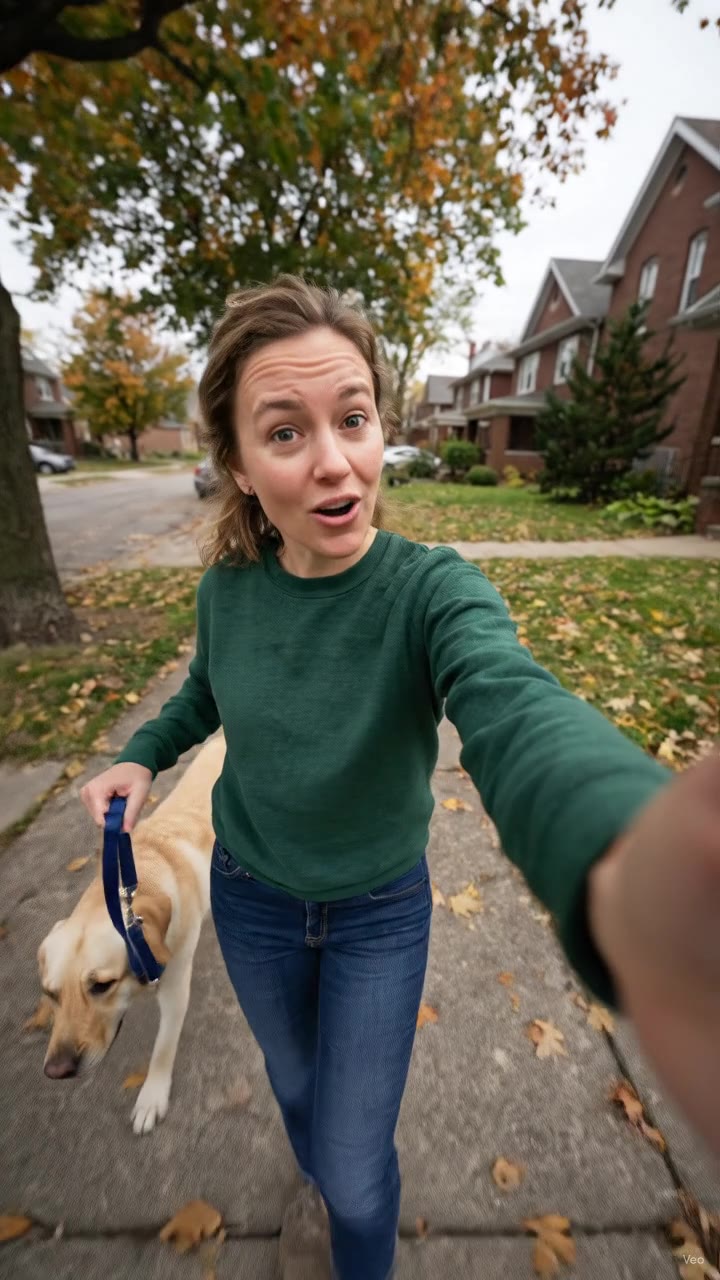
Loose-Leash Mechanics is a 5-lesson, reward-based walking supplement — equipment fit, the stop-and-stand reset, pace changes, and reward placement that teaches your dog to walk beside you instead of dragging you down the street.
Every walk starts the same way. You clip the leash on and within thirty seconds your dog is at the end of it, pulling like a sled dog who just heard the word 'mush.' Your shoulder aches, your wrist burns, and you spend the entire walk bracing against sixty pounds of enthusiasm that has exactly zero interest in staying next to you. Leash pulling is a learned habit — and it can be un-learned with the right mechanics. No yanking, no corrections, no pain. Just five techniques that change what 'leash tension' means to your dog.
▶
Watch: The Calm Walk transformation
You know the walk. Clip the leash, open the door, and within four steps your dog is at the end of it. Arms stretched, shoulder burning, wrist twisted around the handle while your dog powers ahead like they've got somewhere important to be and you're the anchor they're dragging along for the ride.
It's not aggression. It's not reactivity. Your dog isn't scared of anything — they're just strong, and enthusiastic, and completely convinced that the fastest way to get to the next smell is to lean into the leash with everything they've got.
You've probably tried saying "heel." It works for three steps. Then the next squirrel appears. You've tried stopping. The dog waits, you walk again, they pull again. You've tried turning around. You walked a hundred yards and turned around forty times and neither of you enjoyed it.
Here's the thing nobody tells you: loose-leash walking isn't about willpower or commands. It's a set of physical mechanics — where you stop, how you move, where you deliver the treat, what your equipment is actually doing to the physics of the walk. Get those mechanics right and the dog figures out the rest. Get them wrong and no amount of "heel" fixes anything.
The five mechanics that change everything
Loose-leash walking breaks down into five teachable skills. Each one builds on the last:
Equipment fit. A badly fitted front-clip harness shifts pressure to the wrong spot and the dog leans into it harder. A flat collar on a strong puller means you're controlling 80 pounds from the neck. Module 1 covers how each piece of equipment changes the physics — and shows you how to fit yours correctly in five minutes.
The stop-and-stand reset. When the leash goes tight, you stop. Not a yank. Not a turn. You just stop and wait. The dog looks back, the leash goes slack, the walk resumes. Pulling = nothing happens. Slack = forward motion. The equation is that simple, and the dog figures it out fast.
Pace and direction changes. If you walk the same speed in the same direction, your dog tunes you out. Why wouldn't they? You're predictable. Module 3 introduces speed-ups, slow-downs, and turns that make YOU the variable the dog has to track.
The penalty-yard drill. Pulling doesn't just fail to gain ground — it costs ground. When the dog surges ahead, you walk backward a few steps. This flips the reinforcement history: pulling used to mean "I get there faster." Now it means "I lose distance." Five minutes of this is worth more than a 30-minute walk where pulling rehearses the whole time.
Reward placement. Where you deliver the treat decides where the dog walks. Feed at your left knee and the dog orbits that spot. Feed at arm's length ahead and you've trained them to walk out front and look back. Module 5 shows the exact hand position, timing, and reward rate — and how to thin treats as the new position becomes habit.
$9
A private trainer charges $75–$150 per session to teach the same loose-leash mechanics in this program. You're getting five structured lessons — equipment fit through reward placement — for less than the cost of lunch.
— Private dog training sessions typically run $75–$150/hour (industry pricing, 2026)
Why corrections make pulling worse
The instinct is to jerk the leash. Pop the collar. "Show them who's boss." But the research is clear: punishment-based leash work doesn't produce better outcomes — it produces worse welfare and the same (or worse) pulling (Ziv, 2017; China, Mills & Cooper, 2020).
A leash pop teaches the dog that forward motion sometimes comes with a painful surprise. It doesn't teach them where to walk instead. The mechanics in this program do the opposite: they show the dog exactly what position pays, exactly what tension costs, and let the dog's own decision-making close the gap.
Pairs perfectly with The Calm Walk Method
If your dog pulls AND reacts to triggers, Loose-Leash Mechanics handles the walking fundamentals while The Calm Walk Method handles the emotional rehabilitation. Many owners start with one and add the other — the techniques stack cleanly because they're built on the same reward-based foundation.
Every lesson is built on reward-based methods — the same peer-reviewed science cited throughout this page.
What owners say
Real before & after — from Pup Class owners
Before
Koda lunged at every dog, person, and bike on our street. Walks were a 20-minute anxiety event I dreaded.
After
Six weeks of threshold work and she checks in with me instead of exploding. We pass dogs at 15 feet now. That felt impossible.
Rachel T., Savannah GADog: 2-year-old German Shepherd mix
Before
Three trainers, two prong collars, zero improvement — just a more anxious dog who kept getting worse.
After
The lesson on trigger stacking changed everything. Understanding WHY he reacted on some days and not others let me set him up to succeed.
James M., Bozeman MTDog: 4-year-old rescue Pit Bull
Results vary. Every dog and situation is different.
See the transformation
▶
Hear from a Pup Class family
Ready to start today?
30-day money-back guarantee. If it's not for you, email us — full refund, no questions asked.
Instant access · 5 audio lessons · ~8 min each · instant access
Peer-reviewed evidence
What the peer-reviewed research says about leash mechanics
Research cited from:PLOS ONEFrontiers in Veterinary ScienceJournal of Veterinary BehaviorApplied Animal Behaviour ScienceScientific ReportsAnimal WelfareJournal of Applied Animal Welfare SciencePhysiology & BehaviorVeterinary RecordJournal of Experimental PsychologyAnimals
Dogs trained with aversive tools show significantly more stress-related behaviour and a more pessimistic emotional state than reward-based trained dogs.
— Vieira de Castro, A.C., et al. (2020). Does training method matter? Evidence for the negative impact of aversive-based methods on companion dog welfare. PLOS ONE, 15(12), e0225023.
Electronic-collar training was not more effective than reward-based training for leash manners and produced significantly more negative welfare indicators.
— China, L., Mills, D.S., & Cooper, J.J. (2020). Efficacy of dog training with and without remote electronic collars vs. a focus on positive reinforcement. Frontiers in Veterinary Science, 7, 508.
Positive reinforcement training produces better obedience outcomes, fewer problem behaviours, and lower welfare risks than aversive methods — no legitimate advantage to punishment-based approaches, only costs.
— Ziv, G. (2017). The effects of using aversive training methods in dogs — A review. Journal of Veterinary Behavior, 19, 50–60.
Across 364 dogs, the more tasks an owner trained with rewards, the better the dog's obedience score — while punishment-based training showed no such benefit and tracked with more problem behaviours.
— Hiby, E.F., Rooney, N.J., & Bradshaw, J.W.S. (2004). Dog training methods: their use, effectiveness and interaction with behaviour and welfare. Animal Welfare, 13, 63–69.
Dogs trained with negative reinforcement displayed more stress signals and looked to their owners less often — the broken trust that keeps a pulling dog tuned out.
— Deldalle, S., & Gaunet, F. (2014). Effects of 2 training methods on stress-related behaviors of the dog (Canis familiaris) and on the dog–owner relationship. Journal of Veterinary Behavior, 9(2), 58–65.
The data, in one picture
Why yanking the leash makes pulling worse
Pulling is a self-reinforcing habit: the dog pulls, they get to the thing they want, pulling works. When owners try to punish pulling out of a dog, the research shows it backfires — the share of dogs that responded with aggression to common corrections:
Hit or kick the dog43%
Growl at the dog41%
Force an item from the mouth39%
Alpha-roll onto the back31%
Stare the dog down30%
Pin the dog to the ground29%
Source: Herron, Shofer & Reisner (2009), Applied Animal Behaviour Science 117(1–2), 47–54 — proportion of surveyed dogs responding aggressively to each technique.
Two approaches. One clear winner.
Punishment-based methods
Reward-based (Pup Class method)
Yank the leash → dog braces harder → pulling becomes a tug-of-war
Stop-and-stand → tension = nothing happens → slack = the walk continues
Walk the same speed, same path → dog tunes you out completely
Pace and direction changes → you become the interesting part of the walk
Treats in random positions → dog doesn't know where to be
Reward at your knee → dog learns the exact sweet spot
Long walks with constant pulling → the habit rehearses every day
Short sessions with clear wins → new default builds fast
What's inside
5 lessons — from why it happens to what you do next
5 audio lessons · about 4 minutes each. Download and listen on any device, at your pace.
Equipment Fit: Harness, Collar, and Head-Halter MechanicsHow each piece of equipment changes the physics of leash tension, where pressure lands on the dog's body, and what correct fit looks like. Getting this right takes five minutes and makes every technique that follows work better.
The Stop-and-Stand Reset: The Core Anti-Pull MoveWhen your dog hits the end of the leash, you stop, plant your feet, and wait. No jerking, no yanking, no turning. The dog learns that tension = nothing happens, slack = the walk continues.
Pace and Direction Changes: Becoming an Unpredictable WalkerSudden slow-downs, speed-ups, and turns that make YOU the interesting part of the walk. When you're unpredictable, they start watching you because they have to.
The Penalty-Yard DrillWhen the dog surges ahead, you walk backwards a few steps before stopping. Pulling doesn't just fail — it actively loses ground. Five minutes of penalty-yard is more productive than a 30-minute pulling rehearsal.
Rewarding the Sweet Spot: Position by Your LegWhere you deliver the treat decides where the dog walks. Exact hand position, timing, reward rate for week one versus week four — and how to thin treats as the new position becomes habit.
Why it works
Built different from everything else you've tried
🔧
Equipment that works WITH your dog.Harness vs collar vs head halter — the honest breakdown. A badly fitted harness makes pulling worse. Module 1 fixes that in five minutes.
🛑
The core anti-pull move.Stop-and-stand: when the leash goes tight, you stop. No jerking, no turning. The dog learns that tension = nothing happens, slack = the walk continues.
🎲
Become unpredictable.Pace changes, direction changes, sudden stops. When you're unpredictable, your dog starts watching you because they have to.
📏
The penalty-yard drill.Pulling doesn't just fail — it costs ground. Three steps forward, two steps back. The equation flips.
🎯
Reward placement decides position.Feed at your left knee and the dog orbits that spot. Feed at arm's length and you've trained them to walk out front. Module 5 nails the mechanics.
Is this program right for you?
This is for you if…
Your dog pulls constantly on every walk — not reactive, just strong and enthusiastic
You've tried 'heel' and it lasts about four steps before the pulling resumes
You want a systematic method, not a YouTube hack that works once
You're willing to do short, focused practice sessions instead of long pulling-rehearsal walks
You want loose-leash walking without prong collars, choke chains, or corrections
This is NOT for you if…
Your dog is leash-reactive (barking/lunging at triggers) — you need The Calm Walk Method instead
You want a device that does the work for you — this is a training protocol
You're not willing to shorten your walks temporarily while the new mechanics take hold
What you're getting
Everything you get for $9
Loose-Leash Mechanics — 5 audio lessons$19
Equipment-fit quick-reference card$7
Penalty-yard drill cheat sheet$5
Total honest value: $31 → today $9 (71% off)
Still on the fence? Watch this.
▶
Hear from a Pup Class family
Full refund · No questions asked
30-day, no-questions-asked money-back guarantee. If it's not for you, email us and we refund every cent — no forms, no hoops.
Most owners see the first clear improvement within 2–3 structured sessions
Counterconditioning works fast at sub-threshold distances because you're working with the nervous system, not against it. Measurable threshold improvement is typical within the first week of deliberate practice.
Reactive dogs can pass comfortably at 20–30 ft after consistent threshold work — down from 50+ ft reactions
The threshold shrinks as the emotional response changes. You don't need a perfect dog — just a measurably calmer one, getting closer over weeks.
Reward-based reactivity protocols reduce stress markers and produce more reliable long-term improvement than suppression methods
Source: Vieira de Castro et al. (2020). PLOS ONE, 15(12), e0225023. The emotional rehabilitation produces lasting change; suppression does not.
Individual results vary. Every dog and situation is different. These outcomes reflect the science-backed methods in the program — not a guarantee of specific results.
Questions, answered straight
How is this different from The Calm Walk Method?
The Calm Walk Method is a 12-lesson program for leash reactivity — dogs that bark, lunge, and lose it at triggers. Loose-Leash Mechanics is a 5-lesson supplement for the physical act of walking: equipment fit, the anti-pull reset, pace changes, reward placement. They complement each other, but either works standalone.
Will I need special equipment?
Whatever you walk your dog with now is fine to start. Module 1 covers the pros and cons of each option — front-clip harness, back-clip, flat collar, head halter — and shows you how to fit it correctly. No expensive gear required.
How long until I see results?
Most owners see a measurable change within the first week of deliberate, short practice sessions. The key is keeping sessions short (5–10 minutes of focused work) rather than long walks where pulling gets rehearsed the whole time.
My dog is really strong — 80+ pounds of muscle. Will this work?
Yes. The methods are physics-based, not strength-based. Stop-and-stand doesn't require you to out-pull your dog — you just stop moving. The dog learns that pulling produces zero forward progress, regardless of their size.
Can I use this alongside The Calm Walk Method?
Absolutely — they're designed to pair. Loose-Leash Mechanics handles the walking fundamentals (equipment, position, reward placement), while The Calm Walk Method handles the emotional rehabilitation for triggers. Many owners do both.
Is there a money-back guarantee?
30 days, full refund, no questions asked. If the method doesn't help your dog — even if you just didn't like it — email support and we refund everything. No forms, no hoops.
Keep learning — free
Free guides on leash reactivity
How to Stop Leash Pulling for GoodLeash pulling is a habit you can change with rewards, not force. Here's the simple, reward-based method to teach a loose-leash walk.
More owner stories
The change you can make happen
Before
She'd start scanning ahead the moment we left the driveway. We were walking at 5am to avoid other dogs.
After
Normal morning walks now. She still notices other dogs but looks at me for her treat instead of going nuclear. The engage-disengage protocol worked.
Sarah W., Raleigh NCDog: 18-month-old Vizsla
Before
We couldn't walk past another dog without a full meltdown. I stopped taking him anywhere — it wasn't fair to either of us.
After
Four weeks in and we walked past a dog at 20 feet with just a look-back. I actually cried. He's not 'fixed' yet but we have a path now and it's working.
Miguel R., Denver CODog: 3-year-old Husky mix rescue
Results vary. Every dog and situation is different.
▶
Another Pup Class family shares their experience
Full scientific bibliography (47 peer-reviewed studies)
Every claim in this program traces back to published, peer-reviewed research. Here is the complete bibliography powering Pup Class programs — 47 studies from 11+ Q1 journals.
Vieira de Castro, A.C., Fuchs, D., Morello, G.M., Pastur, S., de Sousa, L., & Olsson, I.A.S. (2020). Does training method matter? Evidence for the negative impact of aversive-based methods on companion dog welfare. PLOS ONE, 15(12), e0225023.
Vieira de Castro, A.C., Barrett, J., de Sousa, L., & Olsson, I.A.S. (2021). Improving dog training methods: Efficacy and efficiency of reward and mixed training methods. PLOS ONE, 16(2), e0247321.
China, L., Mills, D.S., & Cooper, J.J. (2020). Efficacy of Dog Training With and Without Remote Electronic Collars vs. a Focus on Positive Reinforcing Methods. Frontiers in Veterinary Science, 7, 508.
Ziv, G. (2017). The effects of using aversive training methods in dogs — A review. Journal of Veterinary Behavior, 19, 50-60.
Guilherme Fernandes, J., Olsson, I.A.S., & Vieira de Castro, A.C. (2017). Do aversive-based training methods actually compromise dog welfare?: A literature review. Applied Animal Behaviour Science, 196, 1-12.
Casey, R.A., Naj-Oleari, M., Campbell, S., Mayfield, M., & Sherwin, A. (2021). Dogs are more pessimistic if their owners use two or more aversive training methods. Scientific Reports, 11, 19023.
Herron, M.E., Shofer, F.S., & Reisner, I.R. (2009). Survey of the use and outcome of confrontational and non-confrontational training methods in client-owned dogs showing undesired behaviors. Applied Animal Behaviour Science, 117(1-2), 47-54.
Blackwell, E.J., Twells, C., Seawright, A., & Casey, R.A. (2008). The relationship between training methods and the occurrence of behavior problems, as reported by owners, in a population of domestic dogs. Journal of Veterinary Behavior, 3(5), 207-217.
Deldalle, S., & Gaunet, F. (2014). Effects of 2 training methods on stress-related behaviors of the dog (Canis familiaris) and on the dog-owner relationship. Journal of Veterinary Behavior, 9(2), 58-65.
Cooper, J.J., Cracknell, N., Hardiman, J., Wright, H., & Mills, D. (2014). The welfare consequences and efficacy of training pet dogs with remote electronic training collars in comparison to reward based training. PLOS ONE, 9(9), e102722.
Hiby, E.F., Rooney, N.J., & Bradshaw, J.W.S. (2004). Dog training methods: their use, effectiveness and interaction with behaviour and welfare. Animal Welfare, 13, 63-69.
Schilder, M.B.H., & van der Borg, J.A.M. (2004). Training dogs with help of the shock collar: short and long term behavioural effects. Applied Animal Behaviour Science, 85, 319-334.
Casey, R.A., Loftus, B., Bolster, C., Richards, G.J., & Blackwell, E.J. (2014). Human directed aggression in domestic dogs (Canis familiaris): Occurrence in different contexts and risk factors. Applied Animal Behaviour Science, 152, 52-63.
Rooney, N.J., & Cowan, S. (2011). Training methods and owner-dog interactions: Links with dog behaviour and learning ability. Applied Animal Behaviour Science, 132(3-4), 169-177.
Butler, R., Sargisson, R.J., & Elliffe, D. (2011). The efficacy of systematic desensitization for treating the separation-related problem behaviour of domestic dogs. Applied Animal Behaviour Science, 129(2-4), 136-145.
Howell, T.J., King, T., & Bennett, P.C. (2015). Puppy parties and beyond: the role of early age socialization practices on adult dog behavior. Veterinary Medicine: Research and Reports, 6, 143-153.
Todd, Z. (2018). Barriers to the adoption of humane dog training methods. Journal of Veterinary Behavior, 25, 28-34.
Arhant, C., Bubna-Littitz, H., Bartels, A., Futschik, A., & Troxler, J. (2010). Behaviour of smaller and larger dogs: Effects of training methods, inconsistency of owner behaviour and level of engagement in activities with the dog. Applied Animal Behaviour Science, 123(3-4), 131-142.
Bradshaw, J.W.S., Blackwell, E.J., & Casey, R.A. (2009). Dominance in domestic dogs — useful construct or bad habit? Journal of Veterinary Behavior, 4(3), 135-144.
Ogata, N. (2016). Separation anxiety in dogs: What progress has been made in our understanding of the most common behavioral problems in dogs? Journal of Veterinary Behavior, 16, 28-35.
Schalke, E., Stichnoth, J., Ott, S., & Jones-Baade, R. (2007). Clinical signs caused by the use of electric training collars on dogs in everyday life situations. Applied Animal Behaviour Science, 105(4), 369-380.
Masson, S., et al. (2018). Electronic training devices: Discussion on the pros and cons of their use in dogs as a basis for the position statement of the European Society of Veterinary Clinical Ethology. Journal of Veterinary Behavior, 25, 71-75.
Salman, M.D., et al. (2000). Behavioral reasons for relinquishment of dogs and cats to 12 shelters. Journal of Applied Animal Welfare Science, 3(2), 93-106.
Kwan, J.Y., & Bain, M.J. (2013). Owner attachment and problem behaviors related to relinquishment and training techniques of dogs. Journal of Applied Animal Welfare Science, 16(2), 168-183.
Fukuzawa, M., & Hayashi, N. (2013). Comparison of 3 different reinforcements of learning in dogs (Canis familiaris). Journal of Veterinary Behavior, 8(4), 221-224.
Flannigan, G., & Dodman, N.H. (2001). Risk factors and behaviors associated with separation anxiety in dogs. Journal of the American Veterinary Medical Association, 219(4), 460-466.
Amat, M., Camps, T., Le Brech, S., & Manteca, X. (2014). Separation anxiety in dogs: The implications of predictability and contextual fear for behavioural treatment. Animal Welfare, 23(3), 263-266.
Scott, J.P., & Fuller, J.L. (1965). Genetics and the Social Behavior of the Dog. University of Chicago Press.
Rescorla, R.A. (1988). Pavlovian conditioning: It's not what you think it is. American Psychologist, 43(3), 151-160.
Seligman, M.E.P., & Maier, S.F. (1967). Failure to escape traumatic shock. Journal of Experimental Psychology, 74(1), 1-9.
Polsky, R.H. (2000). Can aggression in dogs be elicited through the use of electronic pet containment systems? Journal of Applied Animal Welfare Science, 3(4), 345-357.
Haverbeke, A., Laporte, B., Depiereux, E., Giffroy, J.-M., & Diederich, C. (2008). Training methods of military dog handlers and their effects on the team's performances. Applied Animal Behaviour Science, 113(1-3), 110-122.
Beerda, B., Schilder, M.B.H., van Hooff, J.A.R.A.M., de Vries, H.W., & Mol, J.A. (1998). Behavioural, saliva cortisol and heart rate responses to different types of stimuli in dogs. Applied Animal Behaviour Science, 58(3-4), 365-381.
Beerda, B., Schilder, M.B.H., van Hooff, J.A.R.A.M., de Vries, H.W., & Mol, J.A. (1999). Chronic stress in dogs subjected to social and spatial restriction. I. Behavioral responses. Physiology & Behavior, 66(2), 233-242.
Appleby, D.L., Bradshaw, J.W.S., & Casey, R.A. (2002). Relationship between aggressive and avoidance behaviour by dogs and their experience in the first six months of life. Veterinary Record, 150(14), 434-438.
de Assis, L.S., Matos, R., Pike, T.W., Burman, O.H.P., & Mills, D.S. (2020). Developing diagnostic frameworks in veterinary behavioral medicine: Disambiguating separation related problems in dogs. Frontiers in Veterinary Science, 6, 499.
Salonen, M., Sulkama, S., Mikkola, S., Liinamaa, J., Hakanen, E., Tiira, K., & Lohi, H. (2020). Prevalence, comorbidity, and breed differences in canine anxiety in 13,700 Finnish pet dogs. Scientific Reports, 10, 2962.
Jagoe, A., & Serpell, J.A. (1996). Owner characteristics and interactions and the prevalence of canine behaviour problems. Applied Animal Behaviour Science, 47(1-2), 31-42.
Owczarczak-Garstecka, S.C., et al. (2025). Association between training methods and owner-reported problem behaviours in dogs enrolled in the 'Generation Pup' longitudinal study in the UK. Journal of Veterinary Behavior, 77, 52-60.
Stellato, A.C., Jajou, S., Dewey, C.E., Widowski, T.M., & Niel, L. (2019). Effect of a standardized four-week desensitization and counter-conditioning training program on pre-existing veterinary fear in companion dogs. Animals, 9(10), 767.
Puurunen, J., et al. (2020). Inadequate socialisation, inactivity, and urban living environment are associated with social fearfulness in pet dogs. Scientific Reports, 10, 3527.
Pluijmakers, J.J.T.M., Appleby, D.L., & Bradshaw, J.W.S. (2010). Exposure to video images between 3 and 5 weeks of age decreases neophobia in domestic dogs. Applied Animal Behaviour Science, 126(1-2), 51-58.
McEvoy, V., Espinosa, U.B., Crump, A., & Arnott, G. (2022). Canine socialisation: A narrative systematic review. Animals, 12(21), 2895.
Konok, V., Doka, A., & Miklosi, A. (2011). The behavior of the domestic dog (Canis familiaris) during separation from and reunion with the owner: A questionnaire and an experimental study. Applied Animal Behaviour Science, 135(4), 300-308.
Yin, S., Fernandez, E.J., Pagan, S., Richardson, S.L., & Snyder, G. (2008). Efficacy of a remote-controlled, positive-reinforcement, dog-training system for modifying problem behaviors exhibited when people arrive at the door. Applied Animal Behaviour Science, 113(1-3), 123-138.
Tiira, K., & Lohi, H. (2015). Early life experiences and exercise associate with canine anxieties. PLoS ONE, 10(11), e0141907.
Storengen, L.M., & Lingaas, F. (2015). Noise sensitivity in 17 dog breeds: Prevalence, breed risk and correlation with fear in other situations. Applied Animal Behaviour Science, 171, 152-160.
Nine bucks. Five lessons. Walks without the tug-of-war.
Reward-based, science-backed, covered by our 30-day money-back guarantee. If it doesn't help your dog, you pay nothing.
We use cookies to deliver your training plan, save your quiz results, remember your progress, and keep your members area working. Disabling them breaks specific features — you can review each one under "Customise preferences." Privacy Policy.
Cookie Preferences
We use different types of cookies and tracking technologies to deliver the best experience. You can customise your preferences below. For full details see our Privacy Policy.