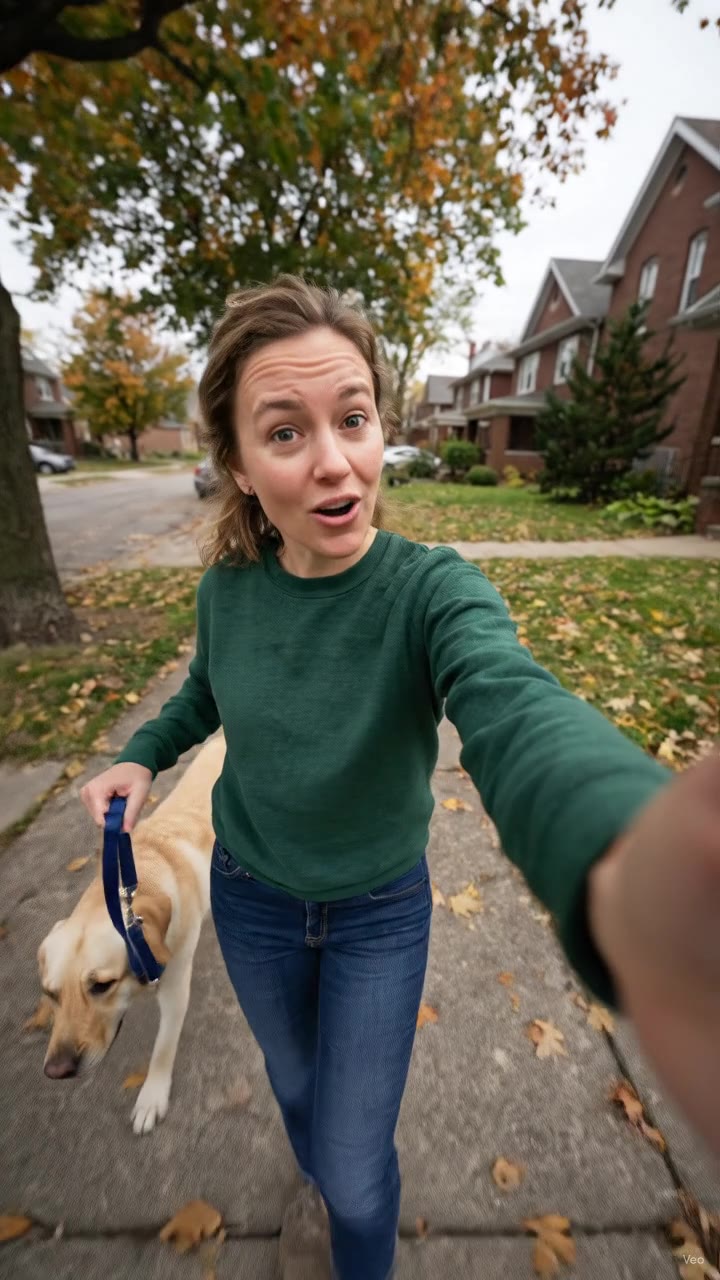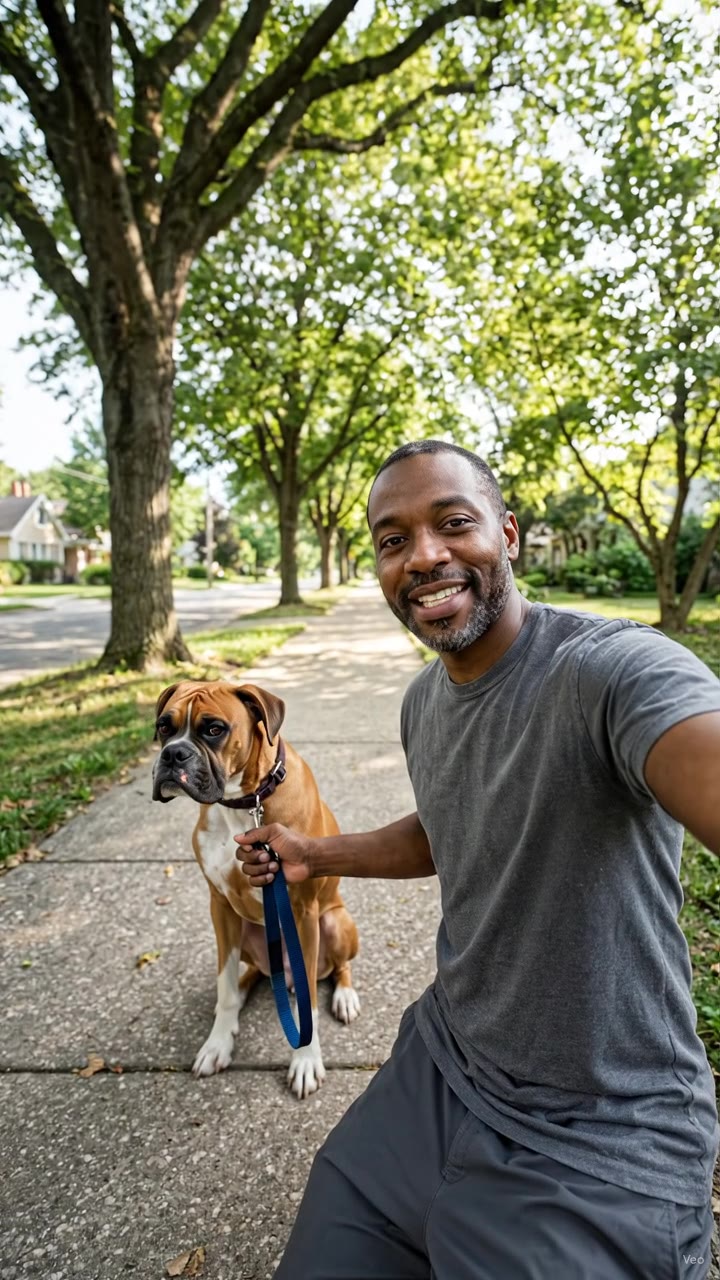
Every morning you walk out that door knowing it's going to happen. Your dog is fine — sniffing the grass, relaxed on the leash — until they're not. The other dog appears and something switches. The lunge. The bark. The spin. Sixty pounds of muscle hitting the end of the leash while your shoulder screams and the whole street turns to look. Your dog has "turned into a lunatic on the leash" again, and you're the one apologizing.
Walks used to be the good part of the day. Now you dread them.
You've probably tried correcting it. Maybe you've yanked the leash. Said "no" firmly. Used a prong collar because someone on the internet said it worked for them. And it either did nothing, or it made things worse.
Here's what no one told you: leash reactivity is a stress response, not a decision. Your dog isn't "being dominant" or "acting out." Their nervous system is flooded — salivary cortisol spikes measurably in dogs during aversive training events (Macchi et al., 2026; Vieira de Castro et al., 2020). They're reacting the way you'd react if something terrifying appeared at the end of a rope you're tied to — you'd panic too.
Yanking that rope doesn't fix the fear. It adds pain to a system that is already overwhelmed.
Why the leash makes it worse — and why that's actually good news
A loose dog who sees something scary has options: circle wide, sniff the ground, walk away, put distance between himself and the thing. A leashed dog has none of those. He's bolted to your side with the trigger coming closer and no way to escape. So his body picks the only strategy left: get big, get loud, make the scary thing go away.
And here's the cruel part — it works. The other dog passes by. The jogger keeps going. From your dog's point of view, the lunging is what kept him safe. Every walk where that happens is a rehearsal that wires the response deeper. That's the bad news.
The good news is the flip side of the same coin: because the behavior is learned, it can be un-learned. You don't need a different dog. You need to change what the trigger means and give your dog a better option than exploding. That's a teachable skill, and it's the whole of this program.
What the science says — and why it changes everything
Peer-reviewed research is consistent: punishing a fear response makes the underlying fear worse (Guilherme Fernandes, Olsson & Vieira de Castro, 2017). Aversive tools suppress the barking and lunging while the emotional state gets more negative. You see a quieter dog for a moment. You've trained an angrier nervous system underneath. Dogs whose owners use multiple aversive methods are measurably more pessimistic — their whole emotional baseline shifts toward threat (Casey et al., 2021).
Vieira de Castro et al. (2020) found dogs trained with aversive methods showed significantly more stress behaviours and a more pessimistic cognitive bias than reward-based trained dogs. China et al. (2020) found e-collar training offered no advantage over positive reinforcement — and produced worse welfare outcomes.
This matters because it tells you what actually works: change what your dog feels about the trigger, not just suppress what they do when they see one.
A certified behaviorist charges roughly $100–$200 an hour to run the exact threshold-and-counterconditioning protocol in this program — and reactivity is never one session. You're getting the same method, laid out step by step, for the price of a coffee.
— Private behavior consults typically run $100–$200/session (industry pricing, 2026)The Calm Walk Method: rebuilding the emotion, one rep at a time
Leash reactivity responds to threshold work + counterconditioning. You find the distance where your dog can see the trigger and still take a treat — that's threshold. You run controlled exposures there, pairing the trigger with something your dog loves. Over reps, the trigger starts to predict good things instead of a threat response.
The skill is in the mechanics: finding threshold accurately, reading early stress signals before the dog tips over, timing the marker correctly, knowing when to increase the challenge and when to add distance. That's what the 12 lessons teach, in the exact order you need them.
Lesson 7 alone — trigger stacking and recovery windows — is worth the price of the program for most owners. Understanding that your dog's cortisol from Monday's walk is still influencing Thursday's changes everything about how you manage bad days (Starling et al., 2013; Cocco et al., 2025).
The 30-day roadmap in lesson 12 gives you the day-by-day plan — what walks to do, what counts as a successful session, and how to measure real progress.
What you'll actually be able to do by the end
This isn't theory you file away. By the time you finish the twelve lessons, here's the walk you'll be running:
- You'll spot the early warning signs — the hard stare, the closed mouth, the freeze — seconds before the lunge, when you can still do something about it.
- You'll know your dog's threshold distance for any trigger, and how to use it so your dog stays under the line where they can still think and eat.
- You'll run the mark-and-feed sequence that turns "oh no, a dog" into "a dog means chicken — where's my human?"
- You'll have a plan for the bad days, the surprise corners, and the off-leash dog that comes out of nowhere.
- And you'll be able to walk your own street, at a normal hour, without scanning every driveway like a hostage negotiator.
What the reactivity is quietly costing you
Be honest about the walk you take now. You go out at 6am or 10pm, the dead hours, because that's when the street is empty. You cross to the other side when you see a leash coming. You've got a mental map of every blind corner and parked van on the route. You've stopped taking your dog to the places you both used to love because you can't trust what happens when the world shows up.
That's not a training problem any more. That's your dog's whole life getting smaller — and yours with it. Every reactive episode is also a rep. Every lunge that "works" (the other dog goes away, because they always do) teaches your dog that lunging is the strategy that keeps them safe. Left alone, reactivity doesn't plateau. It rehearses. It gets more efficient. The window where it's easiest to change is the one you're standing in right now.
Why this isn't "everything you already tried"
When someone says "I've tried everything and nothing worked," what they almost always mean is they tried corrections — the leash pop, the stern "no", the spray bottle, the prong, the e-collar. Look at the chart again. Those aren't a different flavour of the same thing as the Calm Walk Method. They're the exact methods the research links to more stress and more aggression in reactive dogs (Schalke et al., 2007; Arhant et al., 2010). Polsky (2000) documented cases where electronic containment collars triggered unprovoked aggression — and Beerda et al. (1998) measured the stress cascade directly: elevated cortisol, increased heart rate, and behavioral shutdown.
The Calm Walk Method works from the opposite direction. Instead of adding a consequence on top of a flooded nervous system, it lowers the intensity until your dog can think again, then deliberately changes what the trigger predicts. Vieira de Castro et al. (2021) confirmed in a controlled trial that reward-only training produces the same learning outcomes as mixed methods — without the welfare cost. Engage–disengage. Counterconditioning. BAT long-line choice work. The same protocols certified behaviorists charge $150 an hour to run — laid out in twelve short lessons you can start on your next walk. If "everything" never included this, then you haven't actually tried everything yet.
Why you're getting 12 lessons for $5
We price the Calm Walk Method as an introduction because we know it works. If it helps your dog — and for the vast majority of reactive dogs it does — you'll trust us with the rest. Some owners get Home Alone or Speak Dog for the next problem they want to tackle. Some get The Good Dog Vault and work through everything at once.
But most people just want their walks back. This does that.
Not sure where your dog sits on the reactivity scale? Take the free 60-second quiz first — it maps your dog's stage and points you to the right starting lesson.