
How to Crate Train a Puppy the Gentle Way
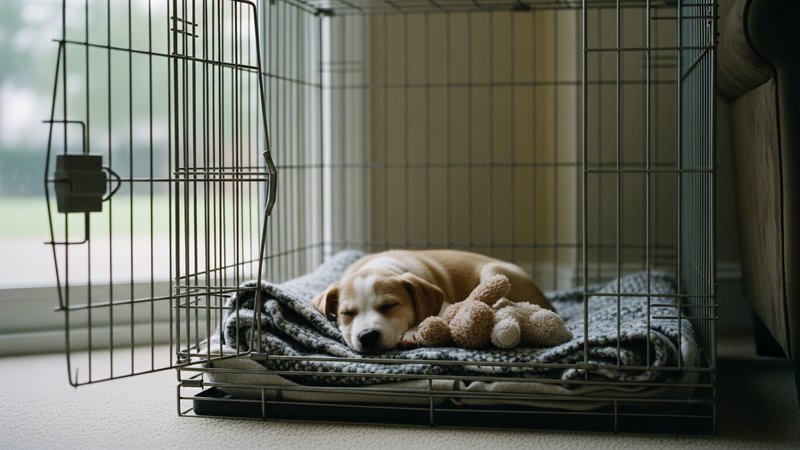
Done well, a crate becomes your puppy's favourite safe den — a cosy spot they choose to relax in, that helps with house training, keeps them safe when you can't supervise, and gives them a calm place to rest. Done badly, it's just a cage they dread. The difference is entirely in how you introduce it. Here's the gentle, reward-based way.
The golden rule: the crate is always a good place
Everything depends on one principle: your puppy should only ever associate the crate with good things. Early positive experiences during the socialisation period have lasting effects on adult behaviour (Howell et al., 2015; Scott & Fuller, 1965), so getting crate introduction right from the start matters. That means the crate is never used as punishment. If you banish your puppy there when you're cross, it becomes a place of dread and the whole plan unravels. Keep it positive, always, and your puppy will come to love it.
Set the crate up right
Before you start:
- Pick the right size. Big enough for your puppy to stand, turn around, and lie down comfortably — but not so cavernous they can toilet in one corner and sleep in another. Many crates come with a divider you can move as your puppy grows.
- Make it cosy. A soft bed or blanket and a safe chew toy inside make it inviting.
- Place it well. Put the crate somewhere your puppy can still feel part of the family — a corner of a living area is often ideal — so being in it doesn't mean isolation.
Step 1: Let your puppy discover it
Don't shut your puppy in on day one. Instead, make the crate the place where good things appear:
- Leave the door open and toss a few treats inside. Let your puppy wander in to get them at their own pace.
- Feed meals near, then inside, the crate so it becomes the place dinner happens.
- Scatter the odd treat in there throughout the day, so your puppy keeps choosing to check it out.
You want your puppy trotting into the crate happily on their own before you ever think about the door.
Step 2: Build up time inside
Once your puppy is comfortable going in, gradually build duration:
- Reward them for settling inside with the door still open.
- Close the door for a second or two, reward, then open it again — before any worry sets in. Build the closed-door time slowly.
- Give a long-lasting chew or stuffed toy to enjoy in the crate, so being inside is genuinely pleasant.
The pace is set by your puppy staying relaxed. If they start to fuss, you've gone a step too fast — drop back to an easier stage and build up again.
Step 3: Practise short absences
When your puppy is happy resting behind a closed door while you're nearby, start stepping away briefly, then returning before they get anxious. Gradually extend how long and how far you go. This teaches your puppy that being in the crate without you is no big deal, and you always come back.
Handling the first nights
The first few nights, a puppy may cry in the crate — they're adjusting to a new home and being alone. A few things help:
- Keep the crate close at night, beside your bed at first, so your puppy isn't isolated and you can reassure them. You can move it further away gradually once they're settled.
- Make sure needs are met. A very young puppy may genuinely need a toilet break in the night — that cry can be a real request, not just protest, so take them out calmly and return them to the crate without fuss.
- Stay calm and low-key so the crate stays a peaceful place.
Crate crying is communication, not manipulation. Dogs trained with punishment-based methods develop more behavioural problems (Blackwell, Twells, Seawright & Casey, 2008), while reward-based approaches are linked to better welfare outcomes (Vieira de Castro et al., 2020). Responding kindly to genuine needs while building positive associations is how your puppy learns to settle.
A crate is a tool, not a storage box
Crates are wonderful for safety and rest, but a puppy shouldn't be crated for long stretches all day. They need company, play, exercise, and frequent toilet breaks. Think of the crate as a cosy bedroom your puppy enjoys, not a place to leave them for hours.
The takeaway
Crate training works when the crate is always a good place — introduced slowly, paired with food and chews, never used as punishment, and built up at your puppy's pace. Want a complete puppy plan that ties crate training in with house training and manners? Explore our reward-based programs, and take the free 60-second quiz to find the best starting point for your dog.
References
Blackwell, E. J., et al. (2008). The relationship between training methods and the occurrence of behavior problems. Journal of Veterinary Behavior, 3(5), 207-217.
Howell, T. J., et al. (2015). Puppy parties and beyond: the role of early age socialization practices on adult dog behavior. Veterinary Medicine: Research and Reports, 6, 143-153.
Scott, J. P., & Fuller, J. L. (1965). Genetics and the Social Behavior of the Dog. University of Chicago Press.
Vieira de Castro, A. C., Fuchs, D., Morello, G. M., Pastur, S., de Sousa, L., & Olsson, I. A. S. (2020). Does training method matter? Evidence for the negative impact of aversive-based methods on companion dog welfare. PLOS ONE, 15(12), e0225023.
- Never use the crate as punishment — every association must be positive
- Let your puppy discover the crate with the door open before ever closing it
- Feed meals inside the crate so it becomes where dinner happens
- Build closed-door time in seconds, then minutes — back off if your puppy fusses
- Keep the crate near your bed the first nights so your puppy isn't isolated
- A crate introduced gently becomes a safe den the puppy chooses; forced confinement creates dread
- Early positive experiences during the socialisation period have lasting effects on adult behaviour
- Crate crying is communication, not manipulation — respond kindly to genuine needs
- Crates are for safety and rest, not long-stretch storage; puppies need company, play, and toilet breaks
Want to go deeper?
Home Alone — Separation Confidence Method is our step-by-step audio programme for separation anxiety. A 12-lesson audio program that teaches your dog to relax when you leave — no punishment, no panic, just science-backed graduated exposure.
See Home Alone — Separation Confidence Method →