
Counterconditioning: Changing How Your Dog Feels
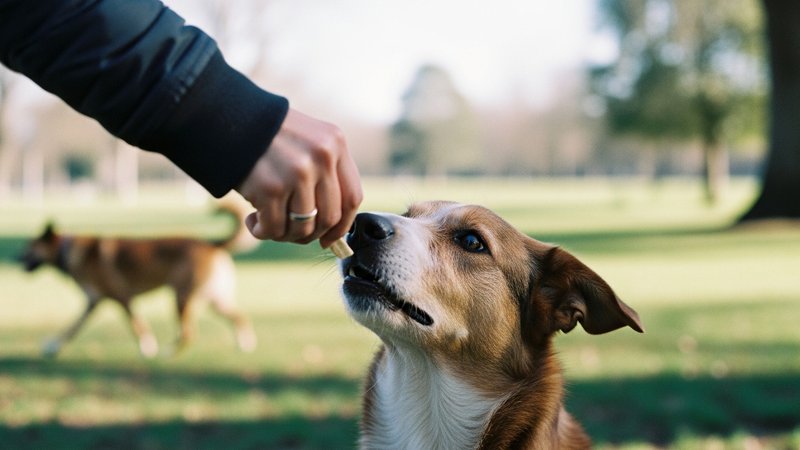
If your dog reacts to other dogs, strangers, or noises, you have probably been told to "correct" the behaviour. But the barking and lunging are just the surface. Underneath is a feeling — usually fear or frustration — and that feeling is what you actually need to change. The reward-based tool for the job is counterconditioning, and it's the engine behind every lasting reactivity fix.
What counterconditioning means
Counterconditioning simply means changing an emotional response from negative to positive. The mechanism rests on well-established Pavlovian conditioning principles (Rescorla, 1988). Right now, your dog might see another dog and feel "uh oh — threat." Counterconditioning teaches your dog to see another dog and feel "oh good — something nice is about to happen."
You do this by reliably pairing the trigger with something your dog loves, at a distance where they can still cope. Over many repetitions, the brain updates its prediction: the scary thing now reliably comes with chicken, and the underlying feeling shifts. Because you have changed how your dog feels, the big reaction is no longer needed.
Why this beats correction
Correction-based methods — a leash pop, a stern word, a shock or prong collar — aim to suppress the outburst. Studies on electronic training collars confirm they compromise welfare without improving outcomes compared to reward-based alternatives (Cooper et al., 2014), and dogs trained with aversive tools display more stress-related behaviours such as lip-licking and yawning (Deldalle & Gaunet, 2014). The problem is that suppression hides the behaviour while leaving the fear intact. Worse, it can stack a new bad experience on top of an already worried dog, so that the sight of another dog now predicts both the original worry and discomfort from you.
The welfare research is consistent on this point: aversive methods are associated with more stress-related behaviour and a more pessimistic emotional state (Casey et al., 2021) — exactly the opposite of what a reactive dog needs. Counterconditioning works with your dog's emotions instead of against them, which is why it tends to last.
The two ingredients you can't skip
Staying under threshold
Your dog's threshold is the distance at which they notice the trigger but can still think, eat, and respond to you. Above threshold, the thinking brain shuts down and no learning happens — your dog is just reacting. Below threshold, the brain is online and ready to form new associations. Every successful counterconditioning rep happens under threshold. If your dog won't take a treat, you are too close; create more space.
Timing and order
The order matters enormously. The trigger appears first, and then the good thing happens. Trigger predicts treat, not the other way around. If you feed before your dog notices the trigger, you teach nothing about the trigger. So you watch for the moment your dog clocks the other dog, and that is your cue to start feeding.
A simple practice loop
- Set the scene. Find a spot where triggers appear at a predictable distance — a quiet park bench, a side street, the edge of a car park.
- Watch for the trigger. The instant your dog notices another dog at a safe distance, start delivering small, delicious treats one after another.
- Stop when it passes. When the trigger is gone, the treats stop. The contrast teaches your dog that good things come with the trigger, not all the time.
- Keep sessions short. A few good reps beat a long session that drifts over threshold.
- Build slowly. Only close the distance when your dog is calm and clearly looking to you for their treat when a trigger appears.
That last point is the whole game: you are looking for a moment where your dog sees a trigger and turns to you expectantly instead of reacting. That look is the sign the emotion is changing.
Patience is part of the method
Emotional change isn't a quick fix, and progress rarely runs in a straight line. A noisy day or a surprise close encounter can set you back a step — that's normal. The dogs who improve are the ones whose owners keep sessions calm, stay under threshold, and let the work add up.
If you'd like this laid out as a complete, follow-along plan with trigger mapping and distance work, that's exactly what our reward-based reactivity programs are designed to walk you through.
The takeaway
You can't correct your way out of an emotion, but you can change it — pair the trigger with something wonderful, stay under threshold, and let the new feeling take root. Curious where your dog stands? Take the free 60-second quiz and get a starting plan built for your dog.
References
Casey, R. A., et al. (2021). Dogs are more pessimistic if their owners use two or more aversive training methods. Scientific Reports, 11, 19023.
Cooper, J. J., et al. (2014). The welfare consequences and efficacy of training pet dogs with remote electronic training collars in comparison to reward based training. PLOS ONE, 9(9), e102722.
Deldalle, S., & Gaunet, F. (2014). Effects of 2 training methods on stress-related behaviors of the dog. Journal of Veterinary Behavior, 9(2), 58-65.
Rescorla, R. A. (1988). Pavlovian conditioning: It's not what you think it is. American Psychologist, 43(3), 151-160.
Vieira de Castro, A. C., Fuchs, D., Morello, G. M., Pastur, S., de Sousa, L., & Olsson, I. A. S. (2020). Does training method matter? Evidence for the negative impact of aversive-based methods on companion dog welfare. PLOS ONE, 15(12), e0225023.
Stellato, A. C., et al. (2019). Effect of a standardized four-week desensitization and counter-conditioning training program on pre-existing veterinary fear in companion dogs. Animals, 9(10), 767.
Beerda, B., et al. (1998). Behavioural, saliva cortisol and heart rate responses to different types of stimuli in dogs. Applied Animal Behaviour Science, 58(3-4), 365-381.
- Pair the trigger with high-value treats at a distance where your dog can still think and eat
- Start feeding the instant your dog notices the trigger, stop when the trigger leaves
- If your dog won't take a treat, you're too close — create more distance
- Keep sessions short: a few good reps beat a long session that drifts over threshold
- Success looks like your dog seeing a trigger and turning to you expectantly
- Counterconditioning changes the underlying emotion, not just the visible behaviour
- Trigger must appear first, then the reward — order matters for the association to form
- Corrections suppress the outburst but leave fear intact, often making it worse
- Progress is nonlinear — setbacks from surprise encounters are normal, not failure
Want to go deeper?
The Calm Walk Method is our step-by-step audio programme for leash reactivity. End the barking and lunging — forever. 12 reward-based audio lessons that rebuild your dog's emotional response to triggers. Just $5 for quiz-takers.
See The Calm Walk Method →